I am delighted to offer in-person piano lessons for those in the Shamrock community and surrounding areas. These lessons are intended for anyone (children or adults) who would like to learn foundational piano skills and music theory. Students will learn to read sheet music, gain technical skills to build finger strength and coordination, and – of course – enjoy the beauty of playing piano music!
If you are interested in lessons, please submit the contact form below.
Thank you and many blessings!
Lesson Specifics
Format
Lessons are 45 minutes each and are held on a weekly basis in my home in Shamrock. Being private, individual lessons, the pace and content can be tailored to the unique goals, capacities, and interests of each student.
Pricing
My usual price for each lesson is $25 and can be paid either weekly or monthly. If cost is a concern for you and your family, please let me know and I am happy to make adjustments as needed. I do not want a child’s opportunity to learn to be hindered by financial constraints.
Scheduling
I offer open enrollment, allowing a student to begin at any time of the year. My availability is kept up to date and is listed below for your convenience. If you have any questions or concerns, I’m happy to speak with you on an individual basis.
Current Openings
**If you do not see a time that works for you and would like to be added to the WAITLIST, please fill out the contact form below.**
Monday: FULL
Tuesday: FULL
Wednesday: 7:00-7:45
Thursday: 2:00-2:45, 4:15-5:00
Friday: 3:00-3:45, 4:15-5:00
Contact
enfoldedheartmusic@gmail.com
**If you have not received a phone call from me within 48 hours, please send me a personal email. Every once in a while the form submission does not make it through and I won’t know unless notified by email. Thank you!
About Me

I have played the piano as long as I can remember and began offering private lessons for the community in 2025. My piano and music theory knowledge comes from twelve years of private piano lessons as well as continued practice, playing, and composition work throughout my adult years. I have been the pianist at St. Patrick’s Catholic Church since 2023 and have released several albums of piano improvisations. For me, music has always been a source of great wonder, joy, and gratitude for the many blessings I have received. It is my hope, therefore, to share the knowledge and skills I received as a young girl with those who desire to play music in their own unique and beautiful way.
In addition to teaching the piano, I also enjoy working with music and a variety of other ways including playing other instruments, composing original music, and providing technical / tuning work for our local pianos. If you would like to learn more, please visit the home website, Enfolded Heart Music, (of which this page is a part of) and click the banner above. Thank you!
Approach to Teaching
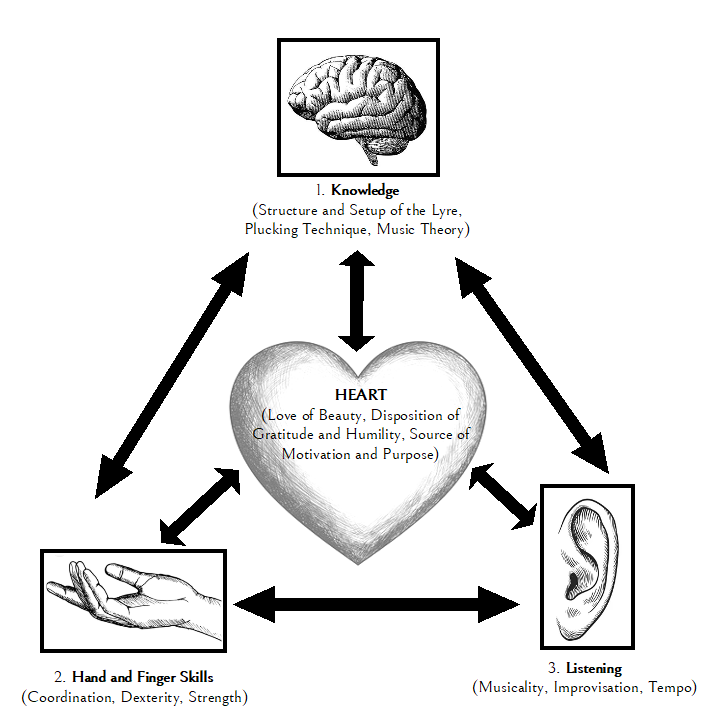
Broadly speaking, I understand there to be three general categories into which the skills of learning a musical instrument can be organized. The categories include knowledge, hand and fingers skills, and listening. These categories, while distinct, also inform and complement one another and are united by a fourth aspect–the heart.
A musician must know the basic structure and characteristics of the instrument in order to understand how to play it most cooperatively and most beautifully. Knowledge of music theory is also integral for musical development and the capacity to both receive and to share music with others. Of course, there are countless other skills and pieces of knowledge that a musician develops as one grows. However, the essential point is that we must know and, in this knowing come to see, the contours of the musical terrain we are adventuring upon. This takes time, practice, patience, and a perspective that keeps the value of this knowledge present during the learning process.
As knowledge grows, it must also be incarnated in a musician’s playing. This requires a kind of education of the hands and fingers in order to develop the capacity to play with strength, coordination, and comfort. It is in this place that finger exercises and repetitive practice come into play. As illustrated in the diagram below, one’s knowledge and technical skills complement one another and each helps to further develop the other. In this way, what we know and what we can play become increasingly aligned.
It may sound a bit silly, but it is common for a young musician to focus so hard on thinking about the notes and playing the right strings that we forget to listen to what we are playing! While it is true that time must be spent focusing exclusively on gaining knowledge and on hand and finger skills, a time must also come when special attention is given to listening with depth and attentiveness. This is typically why I consider listening to be the third aspect of playing, though it is by no means of least importance. It is through listening that the musicality of our playing can be developed (including dynamic and expressive playing), as well as assessing steadiness of tempo and tone. Listening is also integral for improvisation to become a truly creative and wonder-filled activity. Again, this aspect both complements and informs the other two; for it is through listening that our hand and finger skills can gain further mastery and we come to know with greater clarity how to play and write beautiful music.
The heart is by far the most important aspect of learning and playing music, though it often resides in the background of our thought and activity, remaining implicit though active and influential. When I speak of the heart, I am referring to that which motivates our activity and the purpose towards which the activity is aimed. As a teacher, I try to cultivate a love of beauty as one central aspect of the heart, as well as a disposition of humility and gratitude throughout the learning and playing process. More than anything else, it is the heart that will most heavily impact a musician’s capacities to cultivate and communicate beautiful music. If the heart is instead full of self-centered motivations or fears of failure or pride at being better than others, to name a few examples, the communication of true and humble beauty will be hindered even if technical skill is well developed. In contrast, love and pursuit of beauty for its own sake, gratitude for the opportunity to participate in such beauty, and a humble heart that desires to be of service to others through the gift of beauty, builds a foundation ripe for wonder, joy, communion, and love to blossom.
Frequently Asked Questions
Typically a child going into 1st or 2nd grade is a good age to begin, but of course, every child is different so some are ready earlier than others. Three primary questions to consider are:
1)What is my child’s attention span and how would he/she do in a 45 minute long session? Would they be fatigued and unable to learn well after 20 minutes, or would they continue to keep interest for the whole time ?
2) Does your child have a foundational knowledge of the alphabet, counting, and right / left hand? Communicating music concepts and even the structure of the piano and music notation, depend on a basic understanding of these concepts. If this foundational knowledge is not yet developed, the child will be confused and the lesson time will be spend on this knowledge rather than music or piano learning.
3) Has your child developed foundational fine motor skills? While swaying or even clapping along to music is a wonderful way to introduce children to rhythm and beat, the piano requires greater fine motor skills in the fingers which can be very difficult for a child who has not yet reached this developmental milestone.
3) How interested in your child in music? Do they enjoy playing with various instruments and show curiosity about music? A child who is not curious will have a particularly hard time staying focused and enjoying the lessons.
A traditional acoustic piano or an electronic keyboard are both suitable for a beginner student to use at home. However, they have different pros and cons to consider before purchasing an instrument. Here are a few things to consider:
Acoustic Piano: Used acoustic pianos are often on sale for free or at a very discounted price (see Facebook marketplace for example). The major challenge is moving the piano from one home to another. They are usually quite heavy and ideally should remain upright, so transportation with a trailer or truck is necessary. The primary cost of an upright piano is the need to have a piano tuner come and tune the strings; a service recommended once every year. (I am currently studying piano tuning and technical work to help make this service more accessible in our community).
Though there is some additional hassle in the beginning and a yearly cost, I would highly recommend purchasing an acoustic piano if you or your child would like to move beyond a beginner level of playing. It is also very likely that your child will be more excited to play a real piano compared to a keyboard since the mechanics, sound, and touch of the keys on an electric keyboard operate in a very limited manner compared to an acoustic piano.
Electronic Keyboard: While an electronic keyboard is much more expensive than an upright piano, the cost of moving and maintenance is lower and easier. If you’re considering this option, I would highly recommend getting a keyboard that is 1) at least 72 keys, though ideally 88 keys 2) has fully weighted keys 3) has hammer dynamics. Without these characteristics, the keyboard will feel very different than a piano and your child’s hands and fingers will not gain the same coordination, strength, and muscle memory that would be needed to play well on a piano. Finally, I would suggest eventually obtaining a sustain pedal if the keyboard does not come with it initially.
As stated above, I do not recommend a keyboard as a long-term option as it greatly limits the musician’s capacity to play higher level music and to work on skills such as dynamics, intonation, and other skills for expressive and quality playing.
The most common place to find an acoustic piano is on Facebook marketplace. I keep a list of pianos currently available in our area which you can view here. Note that I have not personally seen the pianos listed nor have I been in contact with the owners so I can only judge from very limited information. However, these pianos seem to be in decent shape and are at a reasonable price (though some might be overpriced a bit from my perspective).
Things to look for and ask about:
- Where has the piano been kept or stored?
- If this location is one that is not regulated by heating or air conditioning, such as a garage, outside, or old house, I would not recommend. A piano is made primarily of wood with a cast iron plate and steel strings. This means that humidity, temperature, and other environmental conditions directly impact the instrument and will effect its performance and maintenance.
- Additionally, if the piano has been in a communal location such as a church or school, know that it may have received more rough treatment compared to a piano used in an individual’s home.
- What are the conditions of the keys?
- If the keys have writing on them, are missing the keytops (the white or black top that goes over the wood of the keystick), or are so ‘sticky’ that many of them does not move up and down without getting stuck, it’s likely the piano has not been well cared for and might need a substantial amount of repair work. While some sticky keys is okay and even some unevenness in the key levels can be fixed without significant repairs, it’s recommended that the piano be playable with only minor exceptions.
- Are there any broken pieces?
- Lift up the lid of the piano and take a look at the action (all the hammers and small moving parts that allow the piano to play a note when a key is struck). See if you notice any parts that are obviously broken such as a broken string, hammer, or other parts that seem in the wrong place. Continue to look at the action while you play each note and see if anything else appears to be broken or not functioning. Having one or two things broken isn’t a huge concern necessarily, but it may also be the case that a few broken parts indicates smaller issues that are more pervasive but not as easily seen to the untrained eye. If possible, try to find a piano with no broken parts that you can see.
- Be sure to look also for any cracks in the piano’s wood. While a crack is not an automatic ‘end game’ for a piano, it can cause some significant issues in the future. Some of these include loss of crown which means the piano will loose its acoustic chamber and projection, and loose / unstable tuning pins that won’t hold a string at its proper tension.
- Has the piano been regularly tuned / serviced?
- The longer a piano waits to be tuned, the more difficult it is to bring it back into its proper tuning and to have it stay there. Also, if a piano hasn’t been regularly tuned (every year is recommended for regular tuning), it may also have other more hidden problems that a technician would see while tuning and be able to fix before it expands to a larger issue.
- Is the piano in tune?
- If the piano is currently not in tune, know that you will need to also pay a piano tuner or technician to come and tune the piano once it’s moved. This is not a deal breaker for purchasing the piano, but something to keep in mind when considering your budget. However, it is generally recommended that you have a piano tuned once it has been moved to a new location and has acclimated for a few weeks.
View a list of acoustic pianos currently avilable in the area